Gulet Charter Turkey: What to Expect on a Blue Cruise
A gulet is not a sailing charter, it is an affordable crewed holiday afloat. What it costs, what the price covers, the Blue Cruise routes, and who it suits.
Turkey lists 105 gulets for charter, and the median one books at EUR12,600 a week for the whole boat. That number scares people off until they do the other piece of arithmetic: a gulet sleeps up to sixteen, so split across a dozen guests it lands near EUR1,050 a head for a week of crewed cruising with a cook aboard. That is the thing most first-timers get wrong about a gulet. It is not an expensive yacht charter. It is an affordable crewed holiday that happens to float.
We aggregate the Turkish gulet fleet from 28 charter operators, most of them working the Turquoise Coast between Bodrum, Marmaris, and Fethiye. Here is what a gulet actually is, what the price covers, and who should book one.
A gulet is not a sailing charter
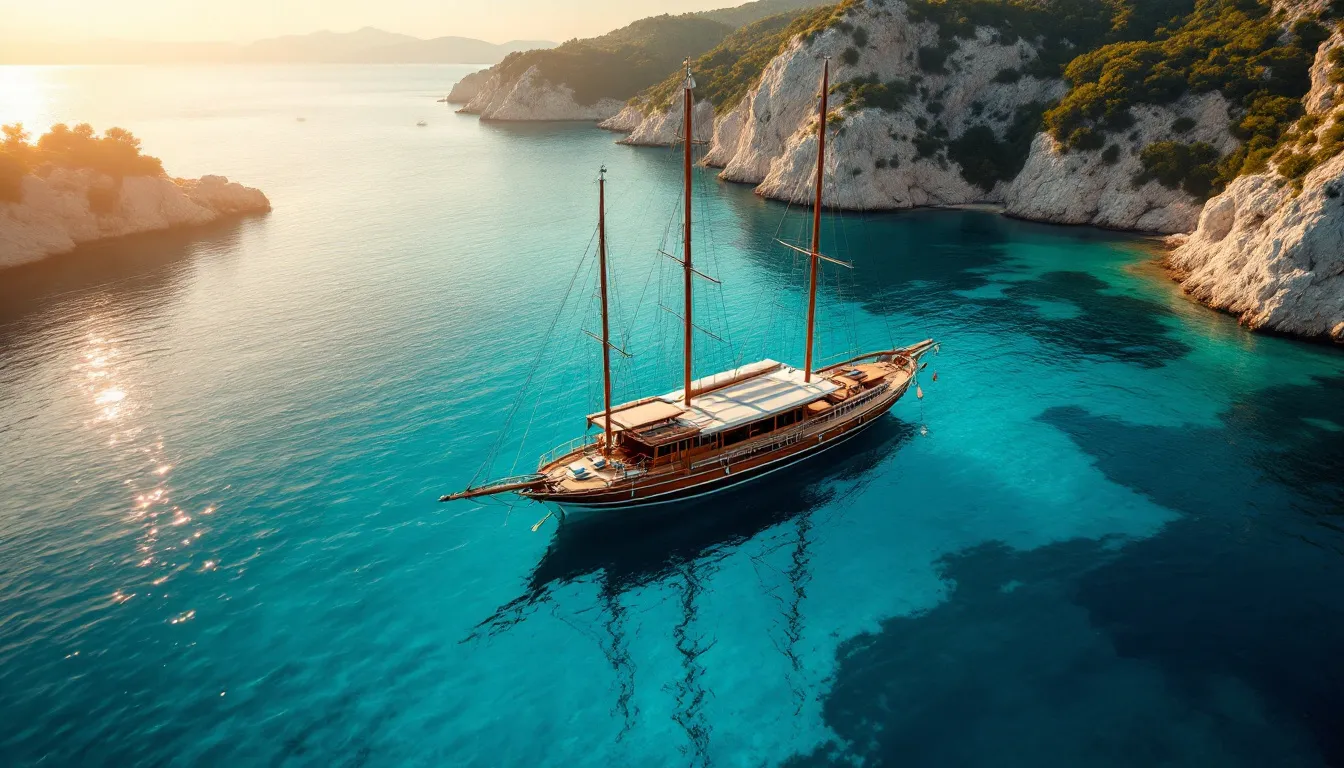
This is the expectation to reset first. A gulet is a broad-beamed wooden motor-sailer, traditionally built in Bodrum and Marmaris, run by a professional crew: a captain, a cook, and usually one or two deckhands. You do not sail it. The crew handles everything, and despite the masts and sails, a gulet motors between bays far more than it sails. The sails are mostly there for steadiness and for the photographs.
So if you want to trim a sheet and take the helm, a gulet is the wrong boat, and you want a Turkish sailing yacht or a bareboat instead. If you want to wake up in a quiet cove, eat a breakfast someone else cooked, swim off the back, and move to the next bay while you read on deck, the gulet is purpose-built for exactly that. It is closer to a small boutique hotel than to a sailing trip.
The price gap reflects this. A Turkish sailing monohull runs a median of EUR2,825 a week and you crew it yourself. A gulet runs EUR12,600 because that number includes a professional crew living aboard and looking after you for seven days.
What the weekly price actually covers
A gulet charter is quoted for the whole boat, not per person, and the headline figure usually covers the boat, the full crew, fuel for normal cruising, water, and harbour fees on the standard route. Bedding and towels come with it. That is the bulk of the cost handled.
The big variable is food. Some operators include full board, three meals a day cooked by the crew, in the headline price. Many quote the boat alone and run food as a separate per-person board package, often EUR250 to EUR400 a head for the week, or let you provision yourselves and pay the cook to prepare it. Always confirm which model a listing uses before you compare two gulets, because a cheaper boat without board can cost more than a pricier all-inclusive one. Drinks are almost always extra and run on a bar tab.
For a group doing the per-person math, the rough rule is the weekly boat price divided by your headcount, plus food, plus drinks, plus crew tip at the end (5 to 10 percent is normal). On a EUR12,600 boat with twelve guests that is about EUR1,050 each for the charter, then maybe EUR350 for food, which is a strong number for a fully crewed week.
Browse 105 Turkish gulets and compare prices
Cabin charter versus private charter
There are two ways to book, and they suit different people.
- Private charter: you take the whole gulet for your group. Total privacy, you set the loose itinerary with the captain, and you fill every cabin with people you know. This is the standard family or friends booking.
- Cabin charter: you book individual cabins on a shared gulet alongside other guests, like a small cruise. Cheaper per cabin, sociable, but you share the boat and a fixed route with strangers. Good for couples and solo travellers who do not have a full group.
Most of our Turkish gulet listings are private-charter boats. The Fethiye area alone has 27 gulets from 11 operators, ranging from EUR6,300 to over EUR50,400 a week depending on size, age, and luxury level, so the spread covers a modest family boat up to a six-cabin showpiece with air conditioning and a jacuzzi on deck.
Where a gulet goes: the Blue Cruise
The classic Turkish gulet route is the Blue Cruise, the Mavi Yolculuk, a week of short hops between sheltered bays where you anchor for swimming and lunch and move on. Three areas anchor most charters.
Fethiye and Gocek is the most popular launch point, a maze of a dozen wooded islands and calm bays inside the Gulf of Fethiye, ideal for a first gulet week because the water is flat and the hops are short. Browse the boats on the Fethiye destination page to see the local fleet.
Bodrum is the other big base, livelier and with easier flights, opening routes toward the Greek Dodecanese and the Gulf of Gokova. The Bodrum destination page covers what leaves from there.
Marmaris and the south toward Kekova and Kas gives you Lycian ruins, the sunken city at Kekova, and quieter water the further east you go. The crew adjusts the route to the wind and to what your group wants, which is part of the appeal: you are not locked to a marina schedule.
What a day aboard actually looks like
The rhythm is the point, so it helps to picture it. Mornings start at anchor in a quiet bay, breakfast laid out on the long aft table while you swim before it gets hot. Mid-morning the crew lifts the anchor and motors a couple of hours to the next spot, you on deck with a book or in the shade of the awning. Lunch is aboard, cooked by the crew, usually at anchor somewhere you can jump straight off the back.
Afternoons are for swimming, paddleboards, a shore visit to a ruin or a beach bar, or simply doing nothing. The boat moves again or stays put depending on the plan. Evenings are dinner on deck as the light goes, then a calm night at anchor or stern-to in a small harbour. Cabins are ensuite and most boats above the budget tier have air conditioning that runs at least while the generator is on. It is unhurried by design, and that is what separates it from a sailing charter where the day revolves around the wind.
Who should book a gulet, and who should not
Book a gulet if you are a group or a family who wants a relaxed, catered week on the water without anyone needing a sailing licence or lifting a finger. It is the best option in Turkey for a multi-generational trip, a celebration, or a group of friends who want to split a memorable holiday and have someone else cook and navigate. Non-sailors get the sea without the work.
Skip the gulet if you actually want to sail, if you want to move fast and far each day, or if you are two people on a tight budget for whom the whole-boat price does not divide down well. A couple is usually better on a bareboat or a cabin charter than paying for a sixteen-berth gulet with fourteen empty bunks.
When to go
The Turkish gulet season runs late April to October. July and August are hot, busy, and the priciest, with sea temperatures in the high twenties and every bay full. June and September are the sweet spot: warm water, calmer anchorages, gentler heat, and rates off the summer peak. May and October are cheaper and quieter, pleasant for cruising and cooler for swimming, with the occasional unsettled day.
Book six to nine months ahead for July and August. A gulet is a fixed asset and the best boats with the best crews get rebooked by returning groups first.
You can compare the current fleet and prices on our Turkey gulet listings.
FAQ
Q: How much does a gulet charter in Turkey cost? The median Turkish gulet is EUR12,600 a week for the whole boat, with the fleet ranging from a few thousand euros up to over EUR75,000 for the largest luxury boats. A gulet sleeps up to sixteen, and split across a dozen guests that works out around EUR1,050 per person for the charter, plus food and drinks.
Q: Do you sail a gulet yourself? No. A gulet comes with a professional crew (captain, cook, and deckhands) who run the boat. You do not need a licence or any experience. Despite the masts, a gulet motors between bays more than it sails, so it is a crewed cruising holiday rather than a sailing charter.
Q: Is food included in a gulet charter? It depends on the operator. Some include full board (three meals a day) in the price, others quote the boat alone and add a food package of roughly EUR250 to EUR400 per person per week, or let you provision and have the cook prepare it. Drinks are almost always extra. Always check which model a listing uses.
Q: What is the difference between cabin charter and private charter? Private charter means you book the whole gulet for your own group. Cabin charter means you book individual cabins on a shared boat alongside other guests, cheaper and more sociable but less private and on a fixed route. Most gulets are booked as private charters.
Q: When is the best time for a gulet cruise in Turkey? June and September are the sweet spot: warm water, calmer bays, and prices below the July to August peak. The season runs late April to October. Book the best boats six to nine months ahead, because good gulets and crews get reserved early.