Catamaran vs monohull: which to charter in Croatia
Catamaran or monohull for your Croatia sailing holiday? This guide covers space, price, motion at sea, the Bora wind, marina access, and which boat type suits couples, families, and larger groups.
The Honest Tradeoffs
Space and Living Comfort
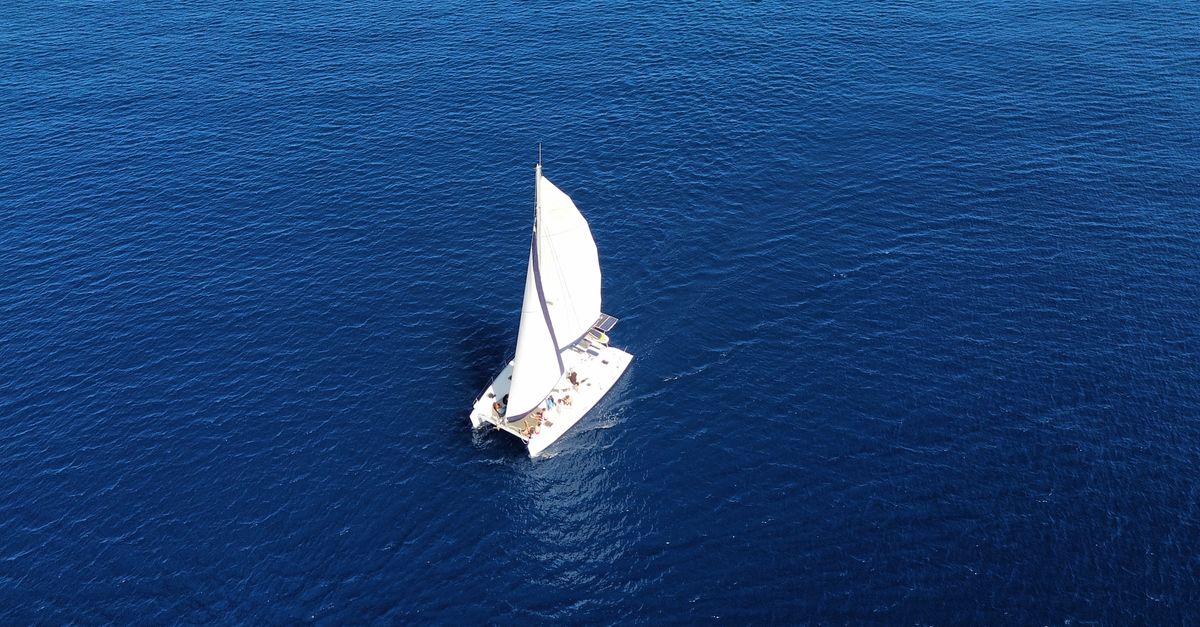
A catamaran and a monohull of similar length occupy fundamentally different amounts of space. The beam tells the story: a Lagoon 42 is 7.44 meters wide; a Bavaria Cruiser 46 is 4.49 meters. That difference in width translates directly into usable area on deck and below.
On a catamaran, the saloon sits level with the cockpit, creating a single large social zone. The two hulls each contain independent cabins with their own heads, which means no queuing for the bathroom in the morning. The cockpit is large enough for a proper table with chairs and room to walk past without climbing over anyone. On a comparable monohull, these same functions are performed in tighter quarters, and the 20-25 degree heel you will experience while sailing means anything not secured will slide.
For groups prioritizing comfort and space, the catamaran wins clearly. For groups where sailing performance matters more than hotel-style living, the calculus changes.
Motion at Sea
Catamarans stay largely flat while sailing. They do not heel the way monohulls do. For anyone prone to seasickness, or for families with young children, this can be the single most important factor in choosing a boat.
The tradeoff is pitching. In short, steep seas, a catamaran's wide stance means the bow and stern move somewhat independently, producing a corkscrew motion that some people find unsettling. In open water with long swells, this is less noticeable.
Monohulls heel, sometimes considerably. In 18-20 knots of breeze on a beat, a well-loaded Bavaria Cruiser 46 will sit at 15-25 degrees. Experienced sailors generally find this feeling natural. For crew who have not sailed before, it requires adjustment. On the upside, monohulls tend to cut through chop rather than slam across it, which produces smoother motion in certain sea states.
Price
The price gap is substantial and consistent across the market. Catamarans cost roughly 60-80% more than a monohull of similar length for the same departure week. A Lagoon 42 in peak season (July-August) typically runs EUR 5,500-7,500 per week; a Bavaria Cruiser 46 in the same period costs EUR 3,200-4,500. The catamaran is also more expensive to berth - marinas charge for beam, and cats occupy more of it - and burns more fuel if you motor frequently with two engines.
Where the catamaran price becomes more defensible is at full capacity. Dividing a EUR 6,500 catamaran charter by 8 guests gives roughly EUR 113 per person per day before additional expenses. That is not trivially more than a crowded monohull at maximum capacity.
Sailing Feel
Catamarans are not ideal upwind. They can struggle to point as efficiently as a monohull, and tacking a large cat in a tight anchorage takes patience and planning. Downwind and on a beam reach, modern cats are surprisingly quick; a Lagoon 42 in 15 knots of true wind on a beam reach can make 8-10 knots without difficulty.
Monohulls communicate more directly. The helm response, the feel of the keel biting upwind, the way the boat accelerates out of a tack - these sensations are more vivid on a monohull. For sailors who charter specifically for the sailing experience, this matters. For groups whose primary interest is the destination and the anchorages, it matters less.
Croatia-Specific Factors
Marina Berths and Catamaran Availability
Croatia's marina infrastructure is well developed, but catamaran berths remain a minority of total capacity. The ACI marina chain, which operates facilities at Split, Dubrovnik, Trogir, the Kornati area, and elsewhere along the coast, has been adding catamaran fingers in recent years, but demand from operators has grown faster than supply. In peak season, catamaran berths at popular marinas such as ACI Split, ACI Hvar, Marina Agana near Trogir, and ACI Dubrovnik fill up days in advance.
This affects how you plan your itinerary. A monohull crew can be more spontaneous, arriving at most marinas with a reasonable expectation of finding space on a stern-to quay or anchoring nearby if the marina is full. A catamaran crew should book key stops at least several weeks ahead in July and August, and ideally further for ACI Dubrovnik, which is consistently the tightest on the coast.
Anchoring overnight is an alternative that many cat crews prefer anyway. Catamarans anchor comfortably due to their stability at rest, and Croatia's islands offer hundreds of suitable bays. In settled midsummer weather, a crew that prefers anchoring to marinas can avoid much of the booking pressure entirely.
The Bora Wind
The Bora is a katabatic wind that descends cold and fast from the Dinaric Alps toward the Adriatic coast. In summer, Bora events are shorter and less severe than in winter, but a summer Bora can still reach 25-35 knots with stronger gusts in the channels - particularly near Senj on the Kvarner coast, in the Novigrad channel, and between the islands of northern Dalmatia. Events typically last 24-72 hours and arrive with little warning.
For a catamaran, the Bora creates specific handling challenges. The wide beam and relatively high freeboard give the boat a large windage profile; in strong gusts, cats drag anchor more readily than narrow monohulls. Marina entry in a Bora requires precise boat handling. The same beam that feels like luxury at anchor becomes awkward when backing into a finger berth in 25 knots of gusty crosswind. This is manageable with experience but demands skill and, ideally, an extra crew member on the bow.
Monohulls present a smaller target to the wind and generally handle Bora gusts more predictably during docking maneuvers. If your group includes newer sailors and you are planning to cruise the Kvarner or northern Dalmatian coast in May, September, or October when Bora frequency is higher, a monohull reduces operational complexity.
Anchorages and Draft
The draft difference between cats and monohulls is significant in Croatian waters. A Lagoon 42 draws around 1.15 meters with daggerboards up. A Bavaria Cruiser 46 draws 2.05 meters on the standard keel. That 90-centimeter difference opens up shallow anchorages to the cat that the monohull must avoid or anchor further back from.
The sandy-bottomed bays of the Zadar archipelago, the shallow lagoons inside some of the Kornati islands, and many small coves throughout Dalmatia are more accessible on a catamaran. You can anchor 20-30 meters closer to the beach, which matters if you are swimming with children or launching a dinghy.
Where catamarans lose access is in narrow coves. Several of Croatia's most scenic anchorages - notably Stiniva on Vis, the narrow bay at Lucica on Lastovo, and some passages between the Kornati islands - have entrances or turning rooms that a 7.4-meter-wide cat cannot safely navigate. A 4.5-meter monohull slips in without difficulty.
Net result: cats and monohulls trade access to different types of anchorages, and neither has a universal advantage across all of Croatia's coastline.
Side-by-Side Specs: Lagoon 42 vs Bavaria Cruiser 46
Lagoon 42 (Catamaran)
- LOA: 12.84 m
- Beam: 7.44 m
- Draft: 1.15 m (daggerboards up)
- Displacement: approximately 11,000 kg
- Cabins: 4 double, 4 heads (standard version)
- Capacity: 8 guests plus skipper
- Engines: 2 x Yanmar 30 hp
- Sail area (main and jib): approximately 122 sq m
The Lagoon 42 has been one of the best-selling charter catamarans in the Mediterranean for several model generations. Its flybridge helm gives excellent visibility over the sails and deck. The cockpit table seats 8 comfortably, and the saloon headroom is adequate for tall crew. The wide aft platform makes boarding from dinghies straightforward and serves as a swimming platform when at anchor.
Bavaria Cruiser 46 (Monohull)
- LOA: 14.27 m
- Beam: 4.49 m
- Draft: 2.05 m (standard keel)
- Displacement: approximately 10,800 kg
- Cabins: 4-5 double, 2-3 heads (configuration varies by model year)
- Capacity: 10 guests plus skipper at maximum
- Engine: 1 x Volvo Penta 55 hp
- Sail area (main and jib): approximately 107 sq m
The Bavaria Cruiser 46 is longer overall than the Lagoon 42 but substantially narrower. Its 5-cabin configuration means it can theoretically sleep more people, but 10 people on a 4.49-meter-wide boat produces a different experience than 8 on a 7.44-meter-wide one. Bavaria's charter fleet is among the largest in Croatia, which means parts and service are widely available and charter base staff are familiar with the boat's quirks.
Note the counterintuitive detail: the Bavaria is the longer boat. Despite this, it offers roughly half the deck area and saloon volume. Overall length and beam together determine usable space on a charter boat, and beam matters more than most first-time charterers expect.
Pricing Comparison
The figures below represent approximate market-rate ranges for 2025-2026 season bookings on vessels 2-4 years old in decent condition. Prices exclude APA (advance provisioning allowance), marina fees, and fuel.
Weekly Charter Rate by Season
Low season (April, May, October):
- Bavaria Cruiser 46: EUR 1,800-2,500 per week
- Lagoon 42: EUR 2,800-4,000 per week
Shoulder season (June, September):
- Bavaria Cruiser 46: EUR 2,500-3,500 per week
- Lagoon 42: EUR 4,000-5,800 per week
Peak season (July-August):
- Bavaria Cruiser 46: EUR 3,200-4,500 per week
- Lagoon 42: EUR 5,500-7,500 per week
Per Cabin Per Night (Peak Season)
Dividing peak-season costs by number of cabins and 7 nights gives a more useful comparison unit:
- Bavaria Cruiser 46, 5 cabins: EUR 91-129 per cabin per night
- Lagoon 42, 4 cabins: EUR 196-268 per cabin per night
The catamaran costs roughly twice as much per cabin in peak season. Whether this is worthwhile depends on how the group weights space and comfort against the price difference.
Additional Costs
Marina fees in Croatian marinas during July and August typically run EUR 35-90 per night for a 14-meter monohull, and EUR 60-140 per night for a catamaran of similar length, depending on the marina and its location. ACI marinas publish their tariffs annually; D-Marin and private marinas vary by facility. Fuel for a week of typical Croatian sailing runs EUR 150-350 for a single-engine monohull and EUR 250-500 for a twin-engine cat, depending heavily on how much you motor.
APA for a skippered charter is typically 20-30% of the charter fee, covering fuel, marina fees, and provisioning. On a bareboat charter, these costs come directly out of your own pocket during the trip.
Verdict by Group
Couples and Small Groups (2-4 People)
For couples or groups of 3-4, a monohull is the better choice in almost every scenario. A Lagoon 42 designed for 8 people is expensive and operationally more complex than necessary for a small crew; much of its space will sit empty. A Jeanneau Sun Odyssey 410, a Bavaria Cruiser 40, or a comparable 40-44 foot monohull gives a couple or small group a well-sized, responsive boat at 40-60% of the catamaran's cost.
If budget is not a constraint and the couple specifically wants the catamaran lifestyle - flat motion, a proper double bed in each hull, room to lay out on the trampoline - then chartering a smaller cat can work. But value-for-money clearly favors the monohull at this group size.
Families of 4-6
This is the scenario where the catamaran argument is strongest. Two adults, two or three children, the gear that travel with families, the need for everyone to sit at the same table at mealtimes, separate heads for each cabin - the catamaran is built for exactly this configuration. Each cabin in a Lagoon 42 has its own head, which eliminates the morning bathroom queue. The flat deck and low freeboard make it easier for children to board from the water. The shallow draft means you can anchor closer to shore.
A Bavaria Cruiser 46 can carry a family of 6 with reasonable comfort, and the weekly cost difference may be EUR 2,000-4,000 in peak season. If the adults are experienced sailors and the family's primary enjoyment comes from sailing rather than floating, a monohull is a defensible choice. If the primary goal is a comfortable Mediterranean holiday that happens to involve a boat, the catamaran is worth the premium for most families in this size range.
Larger Groups (8-12 People)
At this group size, the most practical decision depends on budget flexibility and whether the group wants to share one boat or have independent sub-units.
A Lagoon 42 accommodates 8 at full comfort or 10 at a stretch. For a group of 10-12, you would need a larger catamaran - a Lagoon 50, a Fountaine Pajot Sanya 57, or similar - which pushes weekly costs into EUR 9,000-14,000 territory in peak season. This can still work out to a reasonable per-person cost if the group is large enough, but it requires more advance planning and a skipper comfortable handling large multihull in Croatian marinas.
An alternative that many large groups underutilize is chartering two monohulls and sailing in company. Two Bavaria Cruiser 46s cost roughly EUR 6,400-9,000 per week combined in peak season, carry up to 20 people, and give each sub-group their own domain. The convoy approach allows more flexibility and distributes decision-making across two boats. The social experience is different - evenings together at anchor, days with your own crew - which suits some groups better than a single shared boat.
Frequently Asked Questions
Do I need a different license to charter a catamaran in Croatia?
No. Croatia requires the same credentials regardless of hull type: a VHF radio operator certificate and a nationally recognized sailing license (the ICC is widely accepted, as are most European coastal skipper certificates). Charter companies may request evidence of prior catamaran experience for large cats, but this is a company policy rather than a legal requirement.
Which handles bad weather better, a catamaran or a monohull?
They handle bad weather differently rather than one being clearly better. Monohulls are self-righting: if knocked down, they recover. Catamarans are extremely stable up to their capsize threshold but difficult to recover if that threshold is exceeded - which in practice requires conditions well beyond typical Croatian summer sailing. For the conditions you will actually encounter on a charter holiday in Croatia, up to 30 knots in a Bora or Jugo, both boat types are safe in the hands of a competent skipper.
Are catamaran berths hard to find in Croatia in peak season?
Yes. Catamaran berths at the most popular marinas fill up weeks or months in advance in July and August. If you are chartering a catamaran, book your key marina stops before finalizing your itinerary, particularly for ACI Dubrovnik, ACI Hvar, and Marina Agana near Trogir. Many crews solve this by prioritizing anchorages over marinas, which works well in settled summer weather and also costs less.
Is a bareboat catamaran charter suitable for someone who has only sailed monohulls?
It depends on the skipper's experience level and the size of the boat. A skipper with substantial monohull offshore experience can adapt to a 42-foot catamaran with some adjustment to docking technique and close-quarters maneuvering. For first-time cat charterers, requesting a day's handover training from the charter base reduces risk significantly. Most charter companies in Split, Trogir, and Dubrovnik offer this service for a modest fee.
When is the best time of year to charter in Croatia?
June and September offer the best balance of conditions, crowds, and price. Winds are consistent but generally manageable (typically Maestral at 10-20 knots on summer afternoons), marinas have availability without the peak-season stress, and prices are 20-35% below July-August rates. July and August deliver more reliable sunshine but also more traffic and the strongest Maestral afternoons. May and October are cheapest and least crowded, but weather is more variable and some facilities operate on reduced schedules.
What deposit do I need for a bareboat charter, and what does it cover?
Damage deposits for bareboat charters in Croatia typically run EUR 1,500-3,000 for a mid-size monohull and EUR 2,500-5,000 for a catamaran. The deposit is held by the charter company and covers damage to the boat not attributable to normal wear, weather, or mechanical failure. Most charterers purchase supplementary charter insurance through the company or a third party, which limits direct liability to a lower excess amount. This is strongly recommended, particularly for catamarans where repair costs are higher.